Reading this on Krawl? Register for free.
Unlock listen-aloud, reading history and personalised feeds — at zero cost.
Free registration unlocks the full Finance Desk
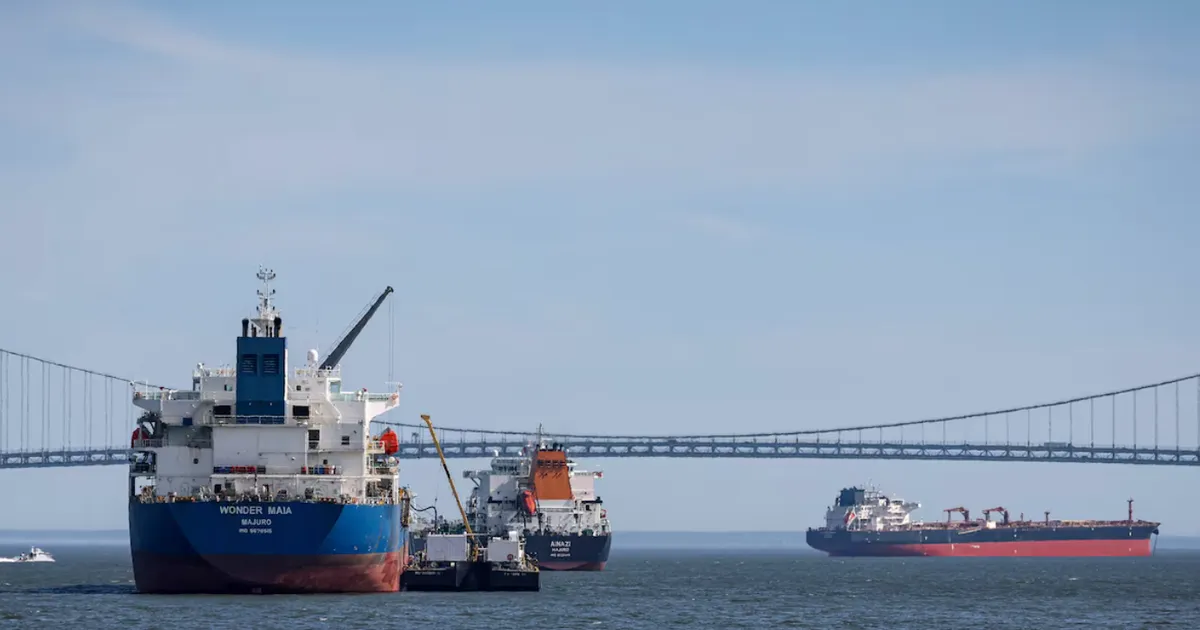
Hong Kong's Role in Shadow Fleets Draws US Sanctions and Interdictions
The US has pursued tankers carrying Venezuelan oil and interdicted vessels linked to shadow fleets, exposing Hong Kong's role as a financial hub for sanction evasion. Treasury actions target entities using Hong Kong addresses.
Targeting Illicit Oil Trade
The US has actively pursued tankers laden with Venezuelan oil from the Caribbean to the Indian Ocean, with Deputy Defense Secretary Pete Hegseth stating that American armed forces will “find you and deliver justice.” This commitment was evident in February when the Aquila II was interdicted following its capture by the US military. Hegseth noted that while the US cannot stop all illegal oil flows, it aims to achieve its objectives by targeting the financial and corporate infrastructure supporting these activities in Hong Kong.
US sanctions are designed to halt the flow of goods, money, or services. However, some Hong Kong entities facilitate these flows, prompting a new report by the China Strategic Risks Institute, a London-based think tank. The report details a network of entities in Hong Kong connected to Venezuelan and Russian shadow fleets.
M., a Russian shadow-fleet vessel, was identified by maritime tracking website VesSelFinder as having changed its name in 2025 to Olina, registered under the ownership of Tantye Peur Ltd., a Hong Kong company. On January 9, the US seized the Olina, which the then-Homeland Security Secretary Kristi Noem stated had departed Venezuela and was “suspected of carrying embargoed oil.”
Two other tankers seized by the US for facilitating Venezuelan oil—the M Sophia and the Sagitta—were also owned by Sunne in January 2025 and listed as part of the Russian shadow fleet, according to Treasury records.
The US Department of Defense confirmed the interdiction of the Aquila II in February.
Hong Kong's Role in Sanctions Evasion
China consolidated control of Hong Kong in 2020, and all business there is now political. Chief Executive John Lee has suggested that foreign sanctions not imposed by the United Nations lack a legal basis.
The CSRI report illustrates how entities in Hong Kong facilitate shadow fleet shipments of Iranian oil, help Tehran acquire weapons, and launder money. The Committee for Freedom in Hong Kong Foundation published this report, noting that Hong Kong companies assist Russia in evading sanctions and acquiring technology for weapons.
To curb these activities, the US needs to enable entities and penalize Hong Kong for harboring them. Imposing sanctions on corporate service providers and logistics firms could expose companies behind illicit activities.
Hong Kong has abused its position as a business hub to undermine US interests. Congress could advance bipartisan legislation that would allow the secretary of state to shut down Hong Kong Economic and Trade Offices in the US. These diplomatic outposts are nominally for commerce, but a recent British espionage case demonstrated how the Communist Party used one for more sinister purposes. The US could designate Hong Kong a primary money-laundering concern under the Patriot Act, which imposes additional due-diligence requirements on Western businesses.
One aspect of Hong Kong’s appeal is its ease of establishing businesses. Hong Kong statistics show that by the end of 2020, there were more than 7,200 licensed trust or company service providers. Under the Chinese Communist Party's authoritarian shadow, Hong Kong has become more like China, making it an illicit business hub.
Jillian Kay Melchior, a London-based member of the Journal editorial board, contributed to this reporting.
Financial Infrastructure as a Target
Targeting financial infrastructure is essential to stop ships involved in evasion.
The Aquila II was captured before its Caribbean exploits, indicating it was already on American authorities' radar. In January 2025, the US sanctioned Sunne, the tanker's owner with a Hong Kong address, for operating in the Russian energy sector. Other ships owned by Sunne were also part of the shadow fleet.
Sunne was not listed as the registered owner of the Aquila II on international maritime records. Instead, the registered owner was Linnet Marguerite Ltd., a Hong Kong address that isn't subject to US sanctions.
Hong Kong requires incorporated companies to appoint a corporate secretary that files annual returns, among other compliance functions. In June 2025, several months after the US said Aquila II was a Sunne asset, Linnet Marguerite changed its corporate secretary to another company with a Hong Kong address, known as Galaxy (Hong Kong) Business Co. Ltd. (referred to as “Galaxy”). Galaxy also maintains an office in Shenzhen.
Galaxy Business states it has clients in Chinese cities and “primarily engages” in business services, including registering companies in Hong Kong, opening a company bank account, bookkeeping, annual reviews, and international trademark registration.
An article on the Galaxy Business website discusses overseas company registration and notes that Hong Kong companies are allowed to have no business operations and exist as shell companies.
In December 2025, the US imposed sanctions on two companies, Corniola Ltd. and Krape Myrtle Co. Ltd., for “operating in the oil sector of the Venezuelan economy.” These companies also had property “interest” in the Nord Star, a tanker that transported Venezuelan oil. Both companies listed Galaxy as their secretary in Hong Kong corporate filings.
When the US sanctioned Sunne, it also owned the Minerva M., a Russian shadow-fleet vessel, and Corniola Ltd. The maritime tracking website VesSelfinder states that in 2025, the Minerva M.’s name changed to the Olina, whose registered owner in maritime records is listed as Tantye Peur Ltd., a Hong Kong company. Its secretary? Galaxy. On January 9 of this year, the US seized the Olina, which the then-Homeland Security Secretary Kristi Noem said had departed Venezuela and was “suspected of carrying embargoed oil.”
Galaxy is not subject to US sanctions. It did not respond to inquiries about its operations and business relationships. The companies’ secretary, Galaxy, is only listed on corporate records for Linnet Marguerite, Tantye Peur, Corniola Ltd., and Krape Myrtle. No one responded to inquiries about these entities.
Sunne was deregistered as an entity last year, according to public filings. Its translator called the corporate secretary listed in its 2024 filings, but the receptionist was unable to provide contact information.
The CSRI report finds that 14 vessels were seized or subjected to sanctions around the capture of Venezuelan dictator Nicolás Maduro, at least ten had ties to Hong Kong.
Found this useful? Share it!
Interested in Finance Education?
Explore our CFA and investing courses — built for serious learners.